Introducing “Pearls”
Written by Tim Fellows & Alex Freeman on June 24, 2026
We’ve been quietly working away at something quite big and exciting here at Octopus, and now it’s starting to go live. It’s a feature we call ‘Pearls’.
We heard from those whose research is working with existing objects, like manuscripts, museum objects or datasets, that the Octopus model was causing them problems. They wanted to be able to start their chain of research from the object(s) they were studying, and to link their analyses and interpretations to it. Where these objects are already digital and online in a repository, we realised that we could pull them in to Octopus (with all their metadata), and that would make it easy for researchers to find them and link their work to them in Octopus.
That’s what a Pearl is: an online object that exists somewhere else, but which we’ve created an Octopus wrapper for, allowing it to be found within Octopus and used as the basis for a chain of publications.
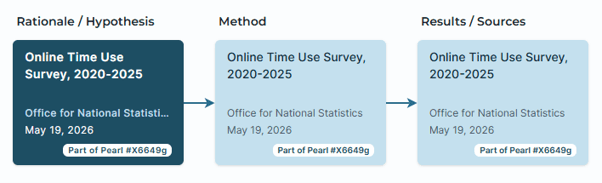
What’s in a Pearl?
One of the reasons that Octopus publication chains can’t normally start with just a ‘Results’ publication is that we know that the method by which that object was produced or obtained (whether it is data, images or a creative work) is important for researchers wanting to use that object for research. So, Pearls will include a Method, and a Rationale wherever possible.
Our very first Pearls are from the UK Data Service, the UK’s largest repository of economic, population and social research data. This means that there are now thousands of big datasets ready to be discovered and linked from, as with any other Octopus publication.
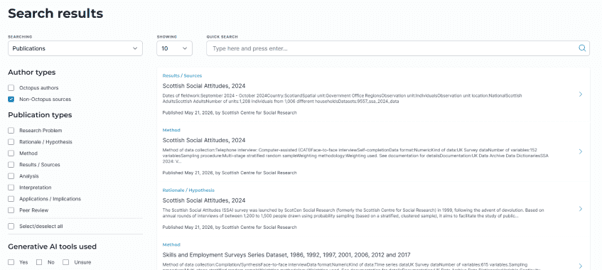
Each Pearl contains links back to the original documentation and datasets on the UK Data Service site for further reading.
Why would I want to link from Pearls?
As well as making digital objects of research and the important contextual information about them easier to find, we hope that being able to link publications from them will be a valuable feature.
Linking an Analysis publication directly from a Pearl Results publication means you can quickly publish your work without having to write all the introductory material that you would in a traditional paper, or start with a Problem as you would normally in Octopus.
It also means that the institution or funder who provided the object you are studying can easily track reuse of their assets and find your work, which could have benefits for everyone.
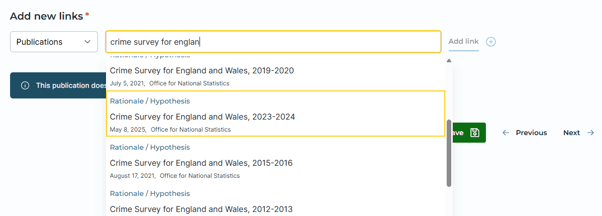
If you want to find and build on Pearls, it’s easy: we’ve created a “Non-Octopus sources” search function.
We know that the visualisations of Pearls (and indeed the whole navigation through chains of publications) isn’t very intuitive or pretty yet, but we wanted to get something out there as soon as possible to help people get working.
If you have any questions or have suggestions for other research repositories that Octopus could link to, please get in touch via alex@octopus.ac.